Showing posts with label Florida. Show all posts

Tuesday, May 28, 2013

What is a Missional Community?


One of the inspirational speakers that I heard at  “Exponential: On The Verge” back in April 2011 in Orlando, Florida was Mike Breen (Bio is at the end of the article). The journey he has been on resonates with my experience. I believe that this could well be an approach that helps us in planting effective churches here in Australia:

What is a Missional Community?
By Mike Breen
Often times people use the phrase ‘missional community’ to describe the state of a group of people. It’s descriptive. The question seems to be, “Is this community missional?” Or, as Neil Cole says, “Is this community joining the mission that God is already doing?” Are we existing as a sent people? It is meant to be descriptive and rather general. The way that I have used this phrase in the past 20 years is a bit more specific and more as a proper noun. Just like the phrase ‘Worship Service’ denotes something quite specific, so the phrase ‘Missional Community’ originated as a very specific thing, identifying a type of missional vehicle that was created in the late 1980’s in the UK.

Sunday, May 08, 2011

Florida Fun

The last three days in Orlando were spent hanging out with Caity, who's spending the year in the States.

We did the toursity / theme-parky thing:

NASA, Cape Kennedy was cool and informative. Absolutely amazing to think of the ingenuity of that team which landed Apollo 11 on the moon with computers using the crunching power of a modern calculator ... Assuming of course, that they DID land on the moon!

We ALMOST saw the very last shuttle launch. Even the Prez was heading down, but they postponed it at the last moment.


No, these are not alien glasses - but 3D glassses for the excellent iMax docos about space.


Universal Studios world  - Here's Caity shamefully pagan in her excitement about Harry Potter world.


One of these is my daughter:


Gee she's got a young looking dad!


We spent some time at Disney World's - EPCOT park, which is sort of a round-the-world theme park,  (different to the fantasy park), it's an interesting and pleasant day's meandering. You walk around a mini version of Germany, Japan, Norway and so on. It's fun, but it's a very happy sweet world where national cliches rule supreme - and you are encouraged to buy mementos at each stage! 

It's amusing that there's a Morocco-world even though the middle eastern Disney stories like Aladdin are set in Iraq and similarly less idyllic places - Morocco though is safe and sanitised!

Yummy tir-fry for tea at China world:


Yes, but can you name all the Disney princesses?


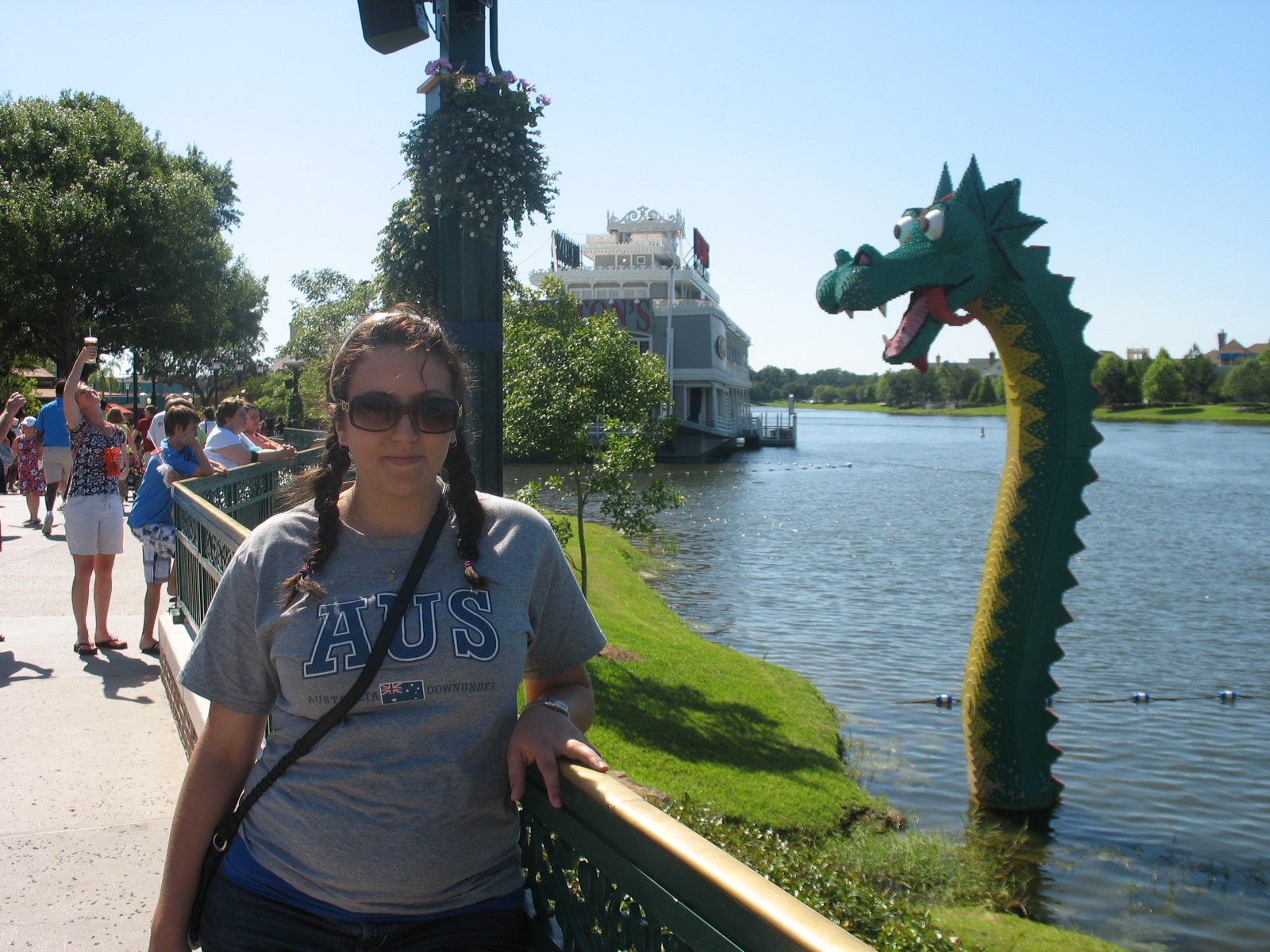
Nothing like a Lego dragon to wrap up a good time!


Friday, May 06, 2011

REFLECTIONS ON EXPONENTIAL 2011

I’ve just got back from Orlando in Florida where I attended the Exponential Conference – On the Verge. This was a huge Church Planting conference with four thousand people attending from around the (mostly) Western world.
In the next few weeks I’ll add further reflections to my blog as well as the Mission and Ministry website.
The Conference started with a member of the Exponential Band setting the stage with a stirring version of Bob Dylan’s anthem, The Times They Are A-changing. Verses two and three are particularly prophetic for our times:

Come writers and critics
Who prophesize with your pen
And keep your eyes wide
The chance won't come again
And don't speak too soon
For the wheel's still in spin
And there's no tellin' who
That it's namin'
For the loser now
Will be later to win
For the times they are a-changin'.

Come preachers and pastors [sic]
Please heed the call
Don't stand in the doorway
Don't block up the hall
For he that gets hurt
Will be he who has stalled
There's a battle outside
And it is ragin'
It'll soon shake your windows
And rattle your walls
For the times they are a-changin'.

In truth the Western Church finds itself on ‘the Verge’. Either we are on the verge of complete extinction – or we are on the verge of a new movement of God. Taken as whole, the decline of Christianity and the church in western contexts continues a-pace. More of the same is not likely to achieve significantly different Kingdom results; so something different is needed.

My first reflections of the Conference:
1.  I believe that we are beginning to get it!  For the first time at a large gathering, including senior ministers from U.S. large churches – the call I hear is that it’s no longer about building bigger, centralised, gatherings-focussed churches, but sending our people out as ‘missionaries’ into neighbourhoods that will never come to us. I recall Francis Chan the Senior Pastor of the Cornerstone Community Church telling about visiting poor and persecuted Christians in India and describing to them about how we do church in the middle-class West, and hearing them laugh-out loud in disbelieve at how ludicrous it sounds! Says Chan: "You go to a building, someone gives you a bulletin, you sit in a chair, you sing a few songs, a guy delivers maybe a polished message, maybe not, someone sings a solo, you go home ... When you read the New Testament, you see the Holy Spirit was supposed to change everything so that this gathering of people who call themselves Christians had this supernatural element about them..." Francis has moved on from pastoring this very large church to focus on building and releasing sacrificial followers of Jesus to live amongst their unchurched neighbours.
2. I believe that God is raising up leaders for the future: I was struck by how many passionate, articulate and competent leaders there were in their 20s and 30s leading and sharing to their generation from the front. My generation needs to heed the words: “Come preachers and pastors, please heed the call, don't stand in the doorway, don't block up the hall.”  New movements will often find greater resistance amongst the gatekeepers of what was once the movement, than from the world outside. Barton Stone as only 29 as a leader of the Cane Ridge Revival! Thomas Campbell wrote the Declaration and Address when he was in his mid-40s and Alexander was just 21. John Wesley was 32 when he began his work. Martin Luther was 34 when he nailed the Ninety-Five Theses to the Wittenberg Cathedral. Samuel Wilberforce was 21 when elected to parliament; and Mother Teresa was 19 when she arrived in India. Doug Nicholls was 29 when he started at the Gore St. Mission Centre.


 3. It’s not about ‘Church’ planting: Our future will not be about duplicating the thing we’ve done for the last few hundred years. Reggie McNeal and many others made the point that he gets very nervous if someone says to him: “I’m called to plant a church.”  The reason is that because alongside our other social silos like politics, commerce, sport, home, justice, education and so on, we Christians have added a new silo called ‘church.’ This is where people come to ‘get’ personal religion;  ‘do’ worship and ‘find’ religious succour. We need to re-imagine our role as being salt and light across all the other silos rather than being a new and separate silo. Says Reggie: “We have too many ‘church’ planters - we don’t need more church planters, but sowers of Kingdom across our cities. We plant Jesus and His Kingdom (Neil Cole) into the arenas of politics, commerce, sport, home, education, and every other field of human endeavour to be transformed. The people alongside us are not ‘church members’ attending to find fellowship - but a ‘band’ of subversive missionaries changing people and culture – who happen to discover koinonia as they serve. I wonder what would it look like to train and send out Jesus ‘agitators’ from our congregations?
4. Our shape needs consideration: Many speakers, such as Mike Breen from the 3DM network talked about ‘Missional Communities’. Mike was for many years the vicar of St Thomas Sheffield in the UK, where he pioneered what he calls missional communities, that is, mid-sized groups of 20-50 people on mission together. Mike talked about early British church history. In the early 5th century, Romans returned as missionaries. The first archbishop of Canterbury, Augustine, built the great Canterbury cathedral. Roman philosophy was attractional: “If you build it they will come.” But the Celtic missionaries, who came a little later, took a different view: “If you go you will reach them.” They got into their coracles and sailed out across North Sea, to northern Europe and beyond. Later as Roman and Celtic philosophies collided – they evolved into the ‘Minister’ movement – which transformed Europe. They melded together the ideas of large monastic or support centres for healing and formation, BUT these centres then send out missionary teams. Like strawberry runners they contextually infiltrated the villages and towns for Christ. Attractional and incarnational melded together. Several speakers spoke about the vitality of small-groups, house-churches and intentional missional communities of 30-50. These are mobile, highly relational and highly adaptive teams that can infiltrate the many new neighbourhoods and fluid networks that mark our 21st century world. My sense is that our larger churches are going to need to learn to become ‘minsters’ that send and sustain a score of smaller and varied ‘parishes’.  How will we learn and adapt in our context?
5. Our measurements will need to change: Our language and our measures become a map that sets us in a particular direction. Language like: “Bringing our friends to church,” or “Going to church,” or “Church attendance was down last week,” or “ We go to Pastor so-and-so’s church,” or “We do outreach at our church,” or “Come to our church’s community programmes,” paints a mental image of church as a location and agency in which things happen. Here we measure attendance numbers, baptisms, age-spread, giving, building-capacity, technological excellence, mid-week groups, pastoral care satisfaction and sizes of church services.  What if our language and measures changed?  Rob Wegner who serves as a teaching pastor at Granger Community Church is working alongside Alan Hirsch in an innovative coaching program called Future Travellers is helping mega-churches become missional movements. “... We are not a church against the community. We are not a church that simply exists within the community. We are a church FOR the community. God told his people while in exile in Babylon to not simply live in the city, but to love it and work for its welfare.  The actual word used is shalom.  Shalom doesn’t just mean peace or a cease-fire of hostility. Shalom means universal flourishing. God’s people are to work for the economic, social, cultural, and spiritual flourishing of their city ...”. What if we began to measure: (1) the authentic friendships the church members were forming outside church programs, (2) the felt needs of the neighbourhood as expressed by them, (3) the identity of the disempowered and marginalised groups in our town, (4) the local agencies our people network with, (5) the actual issues people tell us they would like solidarity and help with, (6) the number of non-church people who share in forming our responses, (7) the daily prayers for our community, (8) the birth of faith communities indigenous to our neighbourhoods, and so on. You get the idea – our agenda might look quite different – but, it would be exactly the same as any good cross-cultural missionary’s usually is!
 Over the next few weeks I will be publishing further articles that talk about different aspects of church planting. The next one will be: Why on earth plant more faith communities in Australia -  of all places? The one after that: How to begin! How you too can be a 'missionary' in your own neighborhood. 


These can also be found on the Mission and Ministry 'Articles' page.


Friday, April 29, 2011

Roll up! Roll Up!

3000 - 4000 attendees shuttling too and fro from workshop to workshop to plenary system to loo break and then back through the common areas to pick up lunch bags, cans of soda, coffee, water, and a space to sit and chat makes for a permanent peak hour! 

Around all the corridors and common areas are sponsors and resource-ministry stalls staffed by friendly and helpful people, often with generous free hand-outs or interesting resources to sell.

To walk around watching the conversations at the stalls tells you a lot about the different dreams and stories the attendees and resource sellers hold. Here's a snapshot:

For these guys, below, marketing media are key. How important is 'hard media' to planting? Interesting how many were using the 'Win a free iPad' worm on their hooks!


 For this mob, compliance, legal, fundraising and insurance issues and consultancy were important. There DVD packs looked well produced. Is doing church inevitably about public events conducted by an incorporation of some sort?


On the other hand, Great Commission Ministries (GCM) mobilizes missionaries to work in their local churches for the purpose of evangelism, discipleship and church planting. They train, employ and serve missionaries as they raise a team of supporters for their ministry.


For these guys its the software you'll need for your new church:


This group was cool - a mobile church - all the bits you need, sound systems, seating, lighting and even a portable coffee shop to accommodate the planter who hasn't yet got a fixed base!


This group can assess your planter's potential:

 These people help you to build a strong team. Teaming, rather than lone rangering is the key to planting sustainably:


World Vision was there, maybe reminding planters that the church is a means not an end:


And this lot can help us make disciples, mot just attendees:


There were seminaries with ubiquitous seedling images:


And South American focussed mission's trips:


 This organization can put together a kit of everything that a planter might need, including a guest services counter!

Everything you need to start a "Cinema Church:"

 Or to reach the 'unreached':

Or the poor:

Maybe you need data or better demographics?


Or perhaps you're just tired out by it all?


Can't remember what these little carrots were selling, but they drew a crowd!


Church content management systems? Websites?


The Catalyst Conference is the largest gathering of young leaders in the country...


 The North east of the USA specifically?


 New Thing "...is to be a catalyst for a movement of reproducing churches relentlessly dedicated to helping people find their way back to God..."


Remember Willow Creek?


Maybe ts books you need? There's some good Aussie titles right there!


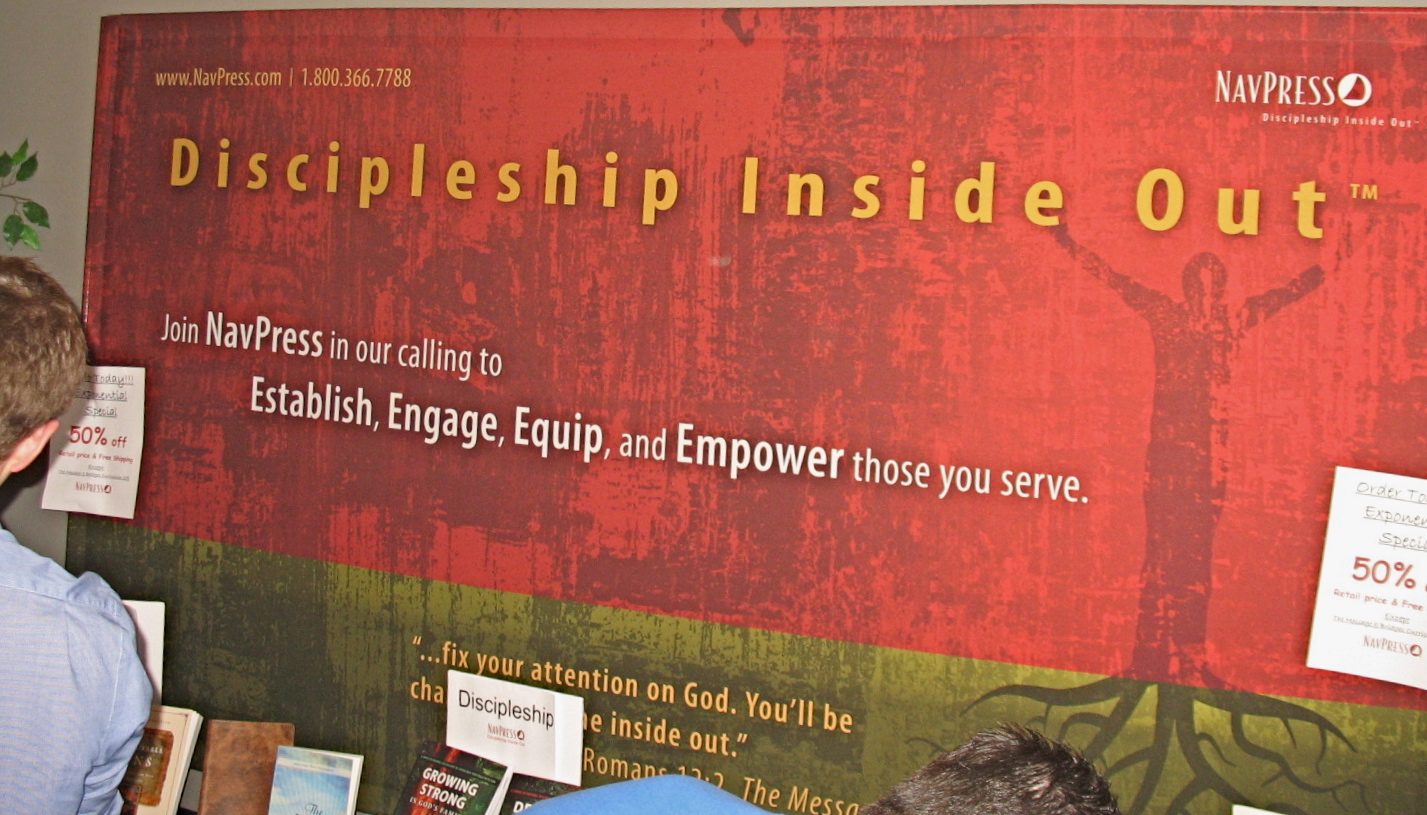
You need to empower those you serve:


Biblical solutions - studies seminars and other resources for life issues people face:


According to Ed Stetzer and Thom S. Rainer, the authors of Transformational Church, "Too often we've highlighted the negative realities of the declining American church but missed the opportunity to magnify the God of hope and transformation."
Based on the most comprehensive study of its kind, including a survey of more than 7,000 churches and hundreds of on-site interviews with pastors, Transformational Church takes us to the thriving congregations where truly changing lives is the norm.


 More on websites for your new church:


 What do you notice about this diverse group of sincere and passionate ministries?  

One thing I noticed both in the stalls and through the conversations was two diverging paradigms of what the mission and model was about. 

The one, a more traditional, attractional, worship-service based, program-event driven (maybe a building-centred) strategy - we are multiplying 'churches' of saved people led by 'leaders' ... 

The other a messier releasing of people to live and participate together in their communities as more organic, lay-driven, justice-bringing and grace-speaking movements that tumble into becoming what might be labelled churches, that multiply before they get too big and concrete (in either sense)

It also struck me that the pendulum is swinging fast towards the latter model!

I also observed that the established judicatories (denominations) tend to do the traditional way - slowly, carefully, within well controlled systems, but the latter is driven by younger, post denominational, networked leaders.

I wonder, will we need to dis-establish our systems to enfranchise God's emerging movement?