
Showing posts with label Church planting. Show all posts
Showing posts with label Church planting. Show all posts
Wednesday, February 21, 2018
Friday, February 09, 2018
Tuesday, April 01, 2014
THRIVING CHURCHES | PART 6 | THE RIGHT CHURCH SHAPE
 Q
5 | DOES OUR SHAPE AND STRUCTURE REFLECT OUR VISION AND
VALUES?
Q
5 | DOES OUR SHAPE AND STRUCTURE REFLECT OUR VISION AND
VALUES?
It
is vital to have an organisational structure (and constitution and policies)
that best supports the mission-field, vision and people. Sometimes it can be
assumed that there is only one traditional ‘shape’ for a church or an agency,
namely a Board; a Minister; and the Congregation with an AGM. Some churches
think that the labels: deacons; elders and pastors define the only ways to
organise, but often they can cause confusion because of the conflicting ways
different Christians understand them.


Tuesday, November 19, 2013
"Why Churches Close" by Martin Robinson
 I enjoy reading Martin Robinson's Blog Café Vista on the Together in Mission website. Martin is an author and the Principal of Springdale College in the U.K. Recently he has posted a series of articles about church planting and renewal.
Here's an interesting recent post:
"Why Churches Close" by Martin Robinson
I am part of a network of churches that is planting congregations at a fair pace. That is the activity we love to talk about and celebrate. However, it is also true that for every three churches we have started we have closed one. That is not a bad average but we don’t often look in detail at the process that ends with a church closure.
I am very conscious that when it comes to the final conversation about closure, the underlying reality is that the church really died some 20 or 30 years before. My observation is that there are at least four key stages in the pathology of decline and closure. I wonder if you recognise any of these stages?
Stage One. The church has been successful and has even seen some growth but there are some warning signs. Leadership does not have a broad vision for mission and tends to treat their minister badly. The leadership and to some extent the congregation has been worried by the growth of the past – too many people coming in who are not quite like us – there is an emphasis on “us” on pastoral needs, on quality issues around worship. Connections with

Read the rest on the Café Vista Blog: HERE
The follow-up article explores what can be done to turn the decline around. Read it here: Life Beyond Death For Churches Near Closure.
Tuesday, June 11, 2013
DAY ONE


I knew Jude many years ago when we were both in the same congregation. It was funny how the evening before in the restaurant I'd noticed her and her husband and thought: "Gee, that woman looks like Jude, but it couldn't be!" But it was, so it was great to catch up on many years of story.
The Conference has brought together about 150 leaders and their teams from churches of all sizes & denominations across the world. I think there were about a dozen nationalities there today. It is being hosted by Network Church, Philadelphia Campus and St. Thomas Church, Crookes here in Sheffield.
Sunday, November 27, 2011
Sunday, July 24, 2011
Missionaries without the Pith Helmets!

A number of years ago some good friends of ours sensed a call to go overseas as missionaries serving in Africa. As they prepared and then said their tearful farewells at the airport, I sort of imagined that they would be on some sort of permanent high intensity Billy Graham Crusade. Rallies in large halls, lights and powerful sound systems, dapper suits and ties, choirs and bands, powerful appeals, tearful responses followed by mass conversions followed in quick succession by a virtual army of builders constructing steepled chapels with rows of fixed pews, pulpits and carpeted stages across the land!
I was quite startled when I realized that much of their next five years would be spent living in an adobe hut in a far dry desert, learning a difficult dialect and making friends with and caring for a people who would never find their way into my imagined Crusade!
The Message paraphrase describes the coming of Jesus into the world like this: “... The Word became flesh and blood, and moved into the neighborhood.” (John 1:14).
Friday, May 06, 2011
REFLECTIONS ON EXPONENTIAL 2011
I’ve just got back from Orlando in Florida where I attended the Exponential Conference – On the Verge. This was a huge Church Planting conference with four thousand people attending from around the (mostly) Western world.
In the next few weeks I’ll add further reflections to my blog as well as the Mission and Ministry website.
The Conference started with a member of the Exponential Band setting the stage with a stirring version of Bob Dylan’s anthem, The Times They Are A-changing. Verses two and three are particularly prophetic for our times:
 Come writers and critics
Who prophesize with your pen
And keep your eyes wide
The chance won't come again
And don't speak too soon
For the wheel's still in spin
And there's no tellin' who
That it's namin'
For the loser now
Will be later to win
For the times they are a-changin'.
Come preachers and pastors [sic]
Please heed the call
Don't stand in the doorway
Don't block up the hall
For he that gets hurt
Will be he who has stalled
There's a battle outside
And it is ragin'
It'll soon shake your windows
And rattle your walls
For the times they are a-changin'.
In truth the Western Church finds itself on ‘the Verge’. Either we are on the verge of complete extinction – or we are on the verge of a new movement of God. Taken as whole, the decline of Christianity and the church in western contexts continues a-pace. More of the same is not likely to achieve significantly different Kingdom results; so something different is needed.
My first reflections of the Conference:
 1. I believe that we are beginning to get it! For the first time at a large gathering, including senior ministers from U.S. large churches – the call I hear is that it’s no longer about building bigger, centralised, gatherings-focussed churches, but sending our people out as ‘missionaries’ into neighbourhoods that will never come to us. I recall Francis Chan the Senior Pastor of the Cornerstone Community Church telling about visiting poor and persecuted Christians in India and describing to them about how we do church in the middle-class West, and hearing them laugh-out loud in disbelieve at how ludicrous it sounds! Says Chan: "You go to a building, someone gives you a bulletin, you sit in a chair, you sing a few songs, a guy delivers maybe a polished message, maybe not, someone sings a solo, you go home ... When you read the New Testament, you see the Holy Spirit was supposed to change everything so that this gathering of people who call themselves Christians had this supernatural element about them..." Francis has moved on from pastoring this very large church to focus on building and releasing sacrificial followers of Jesus to live amongst their unchurched neighbours.
2. I believe that God is raising up leaders for the future: I was struck by how many passionate, articulate and competent leaders there were in their 20s and 30s leading and sharing to their generation from the front. My generation needs to heed the words: “Come preachers and pastors, please heed the call, don't stand in the doorway, don't block up the hall.” New movements will often find greater resistance amongst the gatekeepers of what was once the movement, than from the world outside. Barton Stone as only 29 as a leader of the Cane Ridge Revival! Thomas Campbell wrote the Declaration and Address when he was in his mid-40s and Alexander was just 21. John Wesley was 32 when he began his work. Martin Luther was 34 when he nailed the Ninety-Five Theses to the Wittenberg Cathedral. Samuel Wilberforce was 21 when elected to parliament; and Mother Teresa was 19 when she arrived in India. Doug Nicholls was 29 when he started at the Gore St. Mission Centre.

3. It’s not about ‘Church’ planting: Our future will not be about duplicating the thing we’ve done for the last few hundred years. Reggie McNeal and many others made the point that he gets very nervous if someone says to him: “I’m called to plant a church.” The reason is that because alongside our other social silos like politics, commerce, sport, home, justice, education and so on, we Christians have added a new silo called ‘church.’ This is where people come to ‘get’ personal religion; ‘do’ worship and ‘find’ religious succour. We need to re-imagine our role as being salt and light across all the other silos rather than being a new and separate silo. Says Reggie: “We have too many ‘church’ planters - we don’t need more church planters, but sowers of Kingdom across our cities. We plant Jesus and His Kingdom (Neil Cole) into the arenas of politics, commerce, sport, home, education, and every other field of human endeavour to be transformed. The people alongside us are not ‘church members’ attending to find fellowship - but a ‘band’ of subversive missionaries changing people and culture – who happen to discover koinonia as they serve. I wonder what would it look like to train and send out Jesus ‘agitators’ from our congregations?
 4. Our shape needs consideration: Many speakers, such as Mike Breen from the 3DM network talked about ‘Missional Communities’. Mike was for many years the vicar of St Thomas Sheffield in the UK, where he pioneered what he calls missional communities, that is, mid-sized groups of 20-50 people on mission together. Mike talked about early British church history. In the early 5th century, Romans returned as missionaries. The first archbishop of Canterbury, Augustine, built the great Canterbury cathedral. Roman philosophy was attractional: “If you build it they will come.” But the Celtic missionaries, who came a little later, took a different view: “If you go you will reach them.” They got into their coracles and sailed out across North Sea, to northern Europe and beyond. Later as Roman and Celtic philosophies collided – they evolved into the ‘Minister’ movement – which transformed Europe. They melded together the ideas of large monastic or support centres for healing and formation, BUT these centres then send out missionary teams. Like strawberry runners they contextually infiltrated the villages and towns for Christ. Attractional and incarnational melded together. Several speakers spoke about the vitality of small-groups, house-churches and intentional missional communities of 30-50. These are mobile, highly relational and highly adaptive teams that can infiltrate the many new neighbourhoods and fluid networks that mark our 21st century world. My sense is that our larger churches are going to need to learn to become ‘minsters’ that send and sustain a score of smaller and varied ‘parishes’. How will we learn and adapt in our context?
5. Our measurements will need to change: Our language and our measures become a map that sets us in a particular direction. Language like: “Bringing our friends to church,” or “Going to church,” or “Church attendance was down last week,” or “ We go to Pastor so-and-so’s church,” or “We do outreach at our church,” or “Come to our church’s community programmes,” paints a mental image of church as a location and agency in which things happen. Here we measure attendance numbers, baptisms, age-spread, giving, building-capacity, technological excellence, mid-week groups, pastoral care satisfaction and sizes of church services. What if our language and measures changed? Rob Wegner who serves as a teaching pastor at Granger Community Church is working alongside Alan Hirsch in an innovative coaching program called Future Travellers is helping mega-churches become missional movements. “... We are not a church against the community. We are not a church that simply exists within the community. We are a church FOR the community. God told his people while in exile in Babylon to not simply live in the city, but to love it and work for its welfare. The actual word used is shalom. Shalom doesn’t just mean peace or a cease-fire of hostility. Shalom means universal flourishing. God’s people are to work for the economic, social, cultural, and spiritual flourishing of their city ...”. What if we began to measure: (1) the authentic friendships the church members were forming outside church programs, (2) the felt needs of the neighbourhood as expressed by them, (3) the identity of the disempowered and marginalised groups in our town, (4) the local agencies our people network with, (5) the actual issues people tell us they would like solidarity and help with, (6) the number of non-church people who share in forming our responses, (7) the daily prayers for our community, (8) the birth of faith communities indigenous to our neighbourhoods, and so on. You get the idea – our agenda might look quite different – but, it would be exactly the same as any good cross-cultural missionary’s usually is!
Over the next few weeks I will be publishing further articles that talk about different aspects of church planting. The next one will be: Why on earth plant more faith communities in Australia - of all places? The one after that: How to begin! How you too can be a 'missionary' in your own neighborhood.
These can also be found on the Mission and Ministry 'Articles' page.
These can also be found on the Mission and Ministry 'Articles' page.

Friday, April 29, 2011
Roll up! Roll Up!
3000 - 4000 attendees shuttling too and fro from workshop to workshop to plenary system to loo break and then back through the common areas to pick up lunch bags, cans of soda, coffee, water, and a space to sit and chat makes for a permanent peak hour!
Around all the corridors and common areas are sponsors and resource-ministry stalls staffed by friendly and helpful people, often with generous free hand-outs or interesting resources to sell.
To walk around watching the conversations at the stalls tells you a lot about the different dreams and stories the attendees and resource sellers hold. Here's a snapshot:
For these guys, below, marketing media are key. How important is 'hard media' to planting? Interesting how many were using the 'Win a free iPad' worm on their hooks!

For this mob, compliance, legal, fundraising and insurance issues and consultancy were important. There DVD packs looked well produced. Is doing church inevitably about public events conducted by an incorporation of some sort?

On the other hand, Great Commission Ministries (GCM) mobilizes missionaries to work in their local churches for the purpose of evangelism, discipleship and church planting. They train, employ and serve missionaries as they raise a team of supporters for their ministry.


This group was cool - a mobile church - all the bits you need, sound systems, seating, lighting and even a portable coffee shop to accommodate the planter who hasn't yet got a fixed base!


This group can assess your planter's potential:

These people help you to build a strong team. Teaming, rather than lone rangering is the key to planting sustainably:

World Vision was there, maybe reminding planters that the church is a means not an end:

And this lot can help us make disciples, mot just attendees:

There were seminaries with ubiquitous seedling images:

And South American focussed mission's trips:


This organization can put together a kit of everything that a planter might need, including a guest services counter!

Everything you need to start a "Cinema Church:"

Or to reach the 'unreached':

Or the poor:

Maybe you need data or better demographics?

Or perhaps you're just tired out by it all?

Can't remember what these little carrots were selling, but they drew a crowd!


Church content management systems? Websites?

The Catalyst Conference is the largest gathering of young leaders in the country...

The North east of the USA specifically?

New Thing "...is to be a catalyst for a movement of reproducing churches relentlessly dedicated to helping people find their way back to God..."

Remember Willow Creek?

Maybe ts books you need? There's some good Aussie titles right there!

You need to empower those you serve:
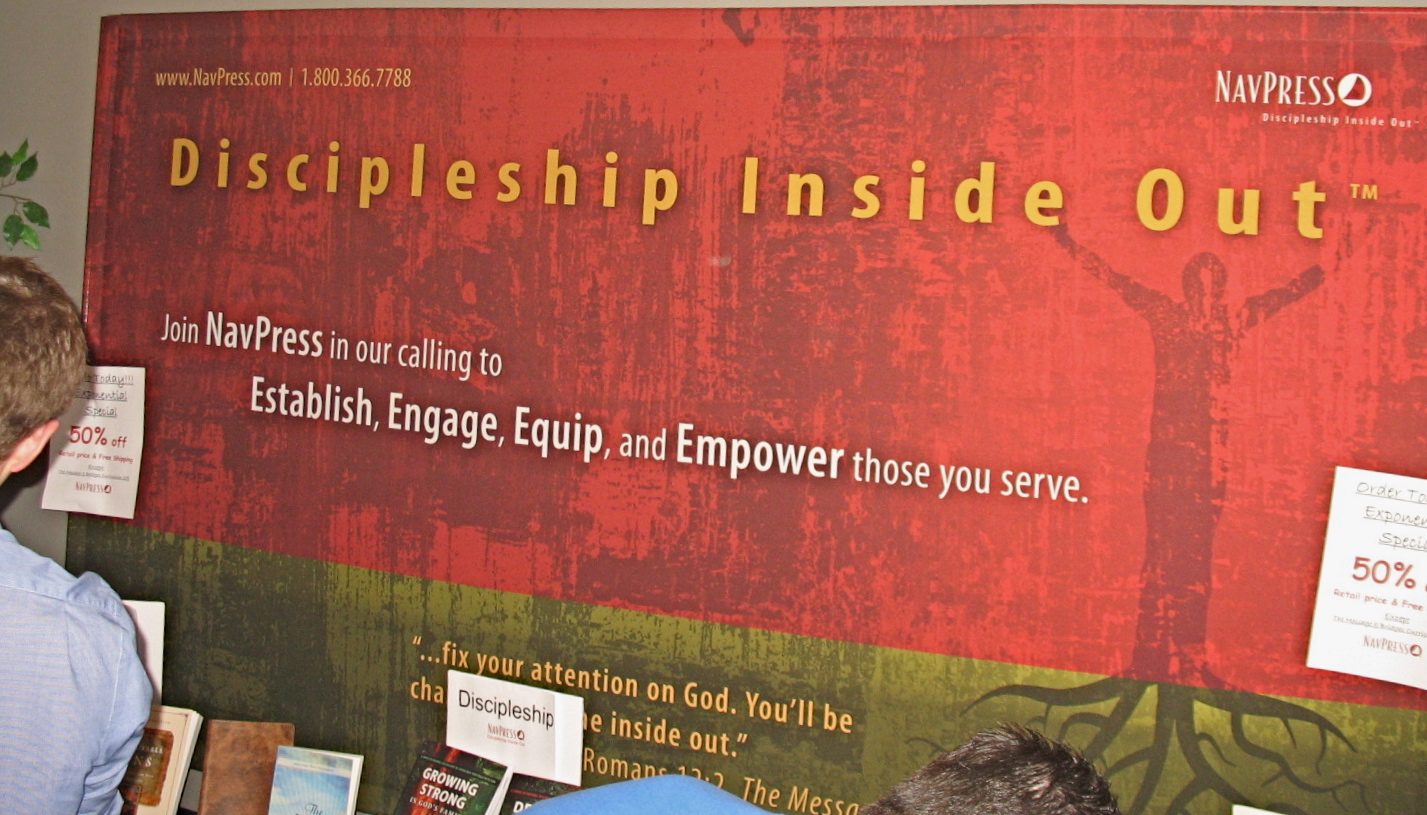
Biblical solutions - studies seminars and other resources for life issues people face:

According to Ed Stetzer and Thom S. Rainer, the authors of Transformational Church, "Too often we've highlighted the negative realities of the declining American church but missed the opportunity to magnify the God of hope and transformation."
Based on the most comprehensive study of its kind, including a survey of more than 7,000 churches and hundreds of on-site interviews with pastors, Transformational Church takes us to the thriving congregations where truly changing lives is the norm.
Based on the most comprehensive study of its kind, including a survey of more than 7,000 churches and hundreds of on-site interviews with pastors, Transformational Church takes us to the thriving congregations where truly changing lives is the norm.


More on websites for your new church:


What do you notice about this diverse group of sincere and passionate ministries?
One thing I noticed both in the stalls and through the conversations was two diverging paradigms of what the mission and model was about.
The one, a more traditional, attractional, worship-service based, program-event driven (maybe a building-centred) strategy - we are multiplying 'churches' of saved people led by 'leaders' ...
The other a messier releasing of people to live and participate together in their communities as more organic, lay-driven, justice-bringing and grace-speaking movements that tumble into becoming what might be labelled churches, that multiply before they get too big and concrete (in either sense)
It also struck me that the pendulum is swinging fast towards the latter model!
I also observed that the established judicatories (denominations) tend to do the traditional way - slowly, carefully, within well controlled systems, but the latter is driven by younger, post denominational, networked leaders.
I wonder, will we need to dis-establish our systems to enfranchise God's emerging movement?
Wednesday, April 27, 2011
26 April 2011 Day one: Pre-Conference Seminar
 It was a hot and sunny day as hundreds of participants descended on the First Baptist campus for the Pre-conference seminars.
Organising things like this is something our American friends do so well. New arrivals were met in the parking lot by red shirted welcomers to registered and directed participants to the right locations. Signs were up everywhere, coffee stations and clockwork lines for our literature and lunch packs.
Around the rooms and corridors were stalls of all sorts about church planting and associated ministries. Interestingly, in this swirl of hundreds of people, the first person I bumped into was Steve Addison near what turned out to be the CRM stall – five minutes later, walking into the men’s loos, I ran into Alan Hirsch! Always a bit awkward striking up conversation there, you get funny looks!

The session I chose was led by Ed Stetzer and his colleagues. This seminar is for network and denominational leaders who work with planters. The website describes it as:
“Best Practices in Denominational and Network Church Planting Systems - Facilitated by Ed Stetzer - Issues church planters face and ways church planting leaders can address them. Ed will share the results of a study on the greatest challenges of church planters.
There were two areas of focus, (1) the "systems" around planting; particularly assessment of potential planters, and (2) church involvement (as in sponsor churches, etc.).
For the assessment portion: John Shepherd (Mountain Lake Church) and Lewis McMullen (Tennessee Baptists) shared about assessment practices. Both of these guys did their post grad research in church planting assessment. Lizette Beard (LifeWay Research) talked about the results of the largest assessment project of its kind-- with new data including predictive factors for church planting success.
For the churches planting churches portion: Rick Fountain (International Pentecostal Holiness Church) talked about their project to engage churches planting churches that has led them to strong planting involvement as a movement.
In the IPHC movement, if you plant a church they celebrate it. And, one way they do that is that those who have planted a church get a special pin to where. And, those who sponsor church plants also get a pin. This is an outworking of a cultural shift to honouring planting. In many denominations, if you are a planter you are seen as a maverick on the margins, particularly in more staid denominations. In the US, I gather, denominational leaders are suspicious; other pastors are critical, etc. And, the result is that the church planter does not feel welcome. These pins are a symbol of recognition, welcome, and appreciation.

Ed Stetzer writes: “... I tell denominational leaders regularly, "What you celebrate, you become." For too many years, my denomination was focused what we were against (though I see that changing). Other denominations did the same. And, it should not surprise us, that when we did not celebrate church planting, we were not strong in church planting. What you celebrate, you become. There are things to be against, but we must be FOR church planting. On the other hand, the last two decades have been the best decades for the IPHC. There are many reasons, I am sure, but one is perhaps symbolized by a couple of pins: for planters and for those who sponsor them....”
William Beasley (an Anglican priest in ACNA) talked about Identifying, blessing and giving scope to the apostolic gift in the raising up of a region of congregations.
Ed Stetzer also expounded on some of the top issues that church planters face, from a project done in partnership with the Exponential Conference. You can find the full report HERE.
1. Leadership Development and Reproducing Culture
2. Financial Self-Sufficiency and Viability
3. Launch Team Development and Mobilizing Volunteers
4. Systems, Processes and Cultures
5. Casting Vision and Avoiding Mission Drift
6. Evangelism and Discipleship
7. Spiritual, Physical and Mental Health of the Planter and Family
 Here’s a summary of some conclusions (from Ed’s blog):
- The challenges of planting commonly result in discouragement and loneliness. The importance of the right point leader (called and wired) is critical in light of the obstacles and challenges of church planting.
- The church planter and family are vulnerable to discouragement and loneliness that comes as a result of spiritual attacks. A solid foundation of faith in God, a surrendered life, and a healthy marriage are critical issues for the lead church planter.
- A rigorous assessment process (sometimes including assistance from a trained clinical psychologist) is important. Key pillars of most organizations' support systems such as assessment, training and coaching are vital.
- Spousal support systems should be added to church planting systems in the future. Most planting organizations focus on pre-launch and launch phases of church planting. Significant opportunities exist for serving planters, their families, and their teams in the post-launch phase.
- Peer-to-peer relationships and church planter networks are vital to meeting the planter's needs of support, encouragement and accountability.
- In this type of plant, getting systems in place in key before going public. Planters should have the following milestones in place before launch: (1) clarity of ministry philosophy (vision, mission, values, leadership culture); (2) solid team of leaders committed to the cause; (3) fundraising support for the planter's family in place; (4) non-negotiable priorities that shape the initial ministries of the church and create a filter for saying "yes" and "no"; and (5) solid core processes and systems in key areas such as discipleship, evangelism, leadership development, and planning.
- Church planting mentors and coaches who speak into the planter's life on a regular basis is important.
- A key issue is discerning the painfully difficult decision between quitting or persevering with the plant during critical times. The Top 7 Issues Planters Face research provides a credible template to build systems and process that address all 7 thus creating more effective church planting environments.
Subscribe to:
Posts (Atom)